LPA Safety Score
The LPA Safety Score is the headline output of every FundAdmin AI review -- a single 0-100 composite number that tells you, at a glance, how LP-friendly or GP-favorable a Limited Partnership Agreement is. Think of it as a credit score for fund documents: higher is safer for the investor, lower means more risk and more negotiation required.
The Safety Score is produced by the 5-agent review pipeline, one of 59 skills in FundAdmin AI's skill suite. After a review completes, the score and all findings can be automatically synced to your Obsidian vault via /fund vault-sync, where they appear in the Portfolio Overview dashboard and feed the Risk Register Kanban board.

What It Is
Every LPA is a unique negotiation between a General Partner (who wants maximum flexibility) and Limited Partners (who want maximum protection). The Safety Score distills hundreds of individual provisions, risk factors, compliance checks, and obligation terms into one actionable number.
The score answers a deceptively simple question: "If I commit capital to this fund on these terms, how protected am I?"
- 0 means the document is catastrophically GP-favorable, with potential dealbreakers in every category.
- 100 means the document is exceptionally LP-friendly, with strong protections, market-standard or better terms, and no hidden traps.
Most real-world LPAs land between 55 and 85. A score below 60 should trigger serious pause; a score above 85 is uncommon and indicates unusually strong LP terms.
How It Is Calculated
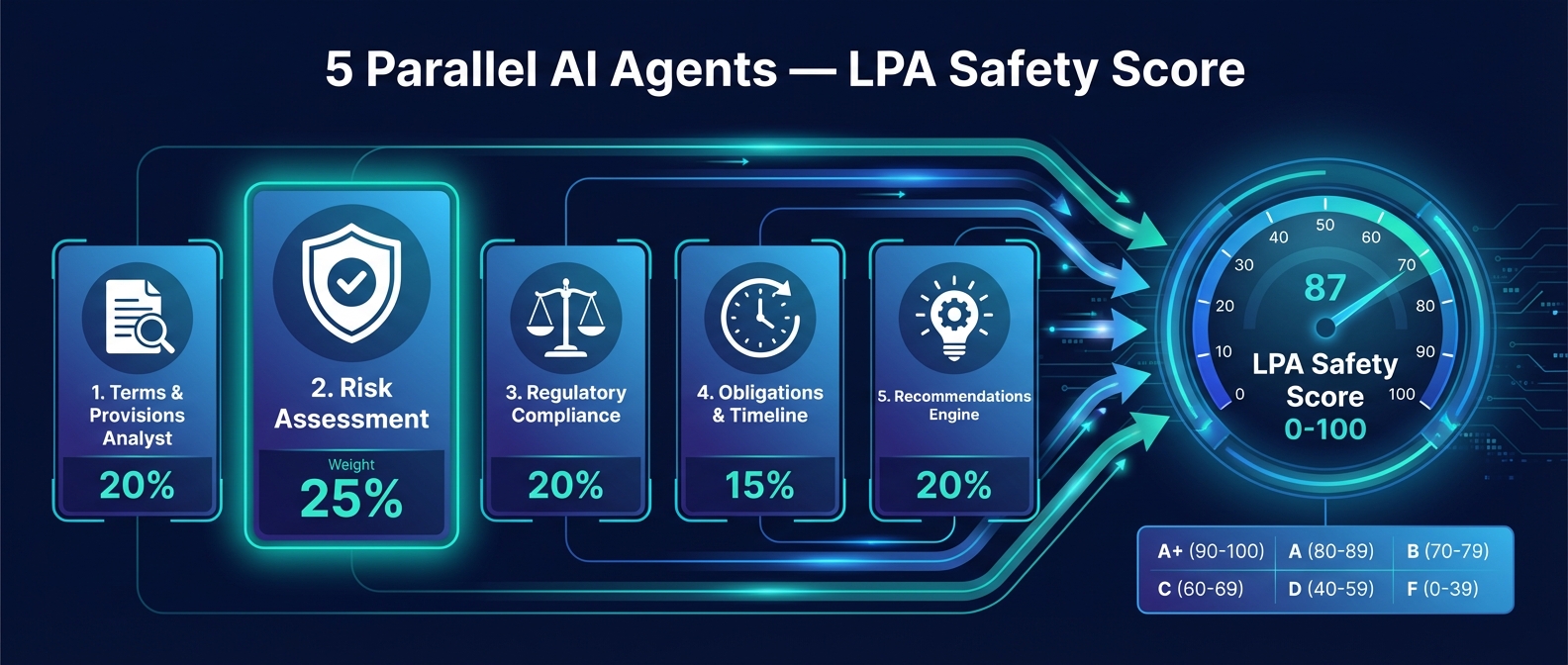
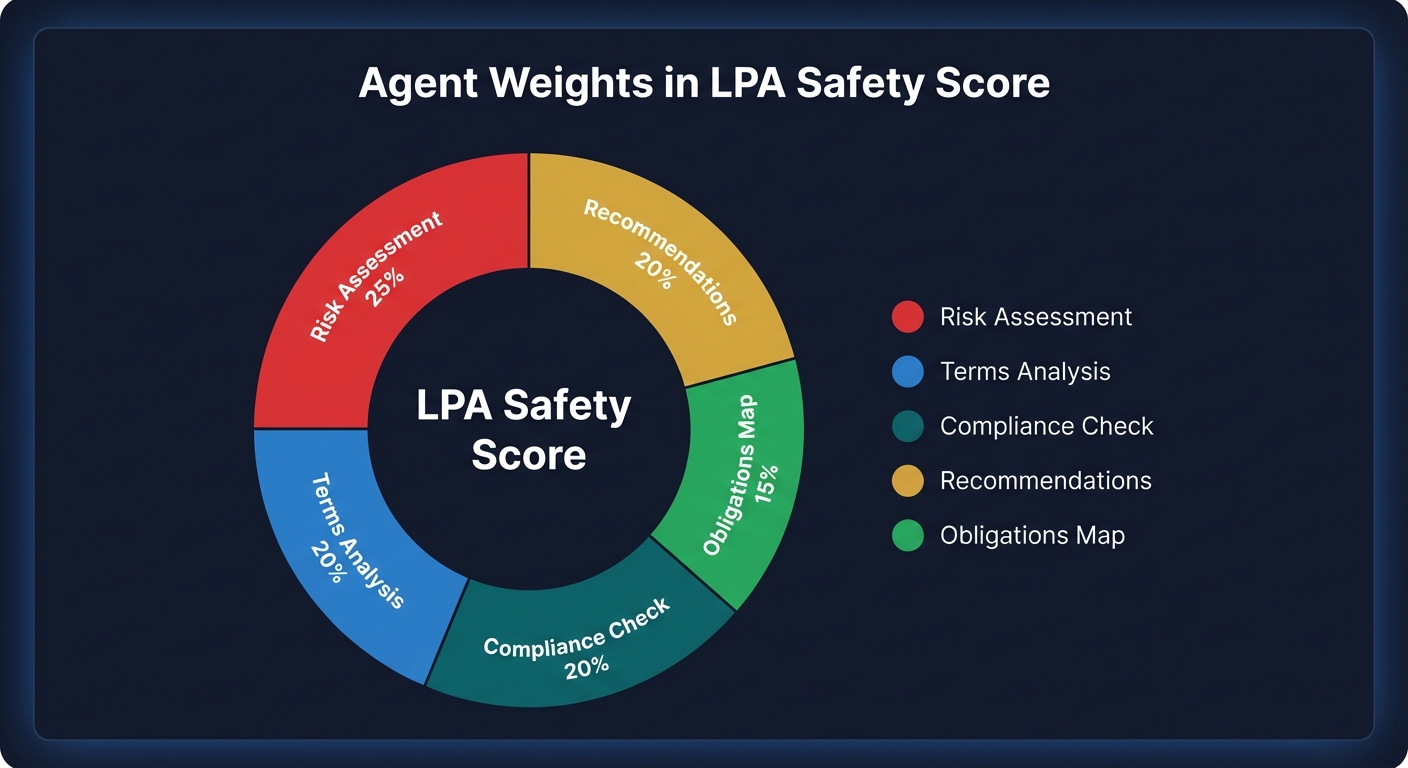
The Safety Score is not a single model's opinion. It is a weighted aggregate produced by five specialized AI agents that analyze every LPA in parallel. Each agent scores its domain independently, and the final composite is computed as:
Safety Score = (Terms * 0.20) + (Risk * 0.25) + (Compliance * 0.20) + (Obligations * 0.15) + (Recommendations * 0.20)Agent Weights
| Agent | Weight | Rationale |
|---|---|---|
| Terms & Provisions Analyst | 20% | Completeness and categorization of all defined terms |
| Risk Assessment | 25% | Highest weight -- risk is the most direct measure of LP exposure |
| Regulatory Compliance | 20% | Non-compliance can invalidate the entire structure |
| Obligations & Timeline | 15% | Important but narrower in scope than risk or compliance |
| Recommendations Engine | 20% | Quality and actionability of generated negotiation guidance |
The weights reflect the relative importance of each dimension to an LP's investment decision. Risk Assessment carries the heaviest weight (25%) because it directly measures financial exposure and GP-LP asymmetry. Compliance matches Terms at 20% because regulatory failures can be existential -- a fund that violates ERISA or SEC rules creates liability that no favorable term can offset.
Why Five Agents Instead of One?
A single model analyzing an 80-page LPA will miss things. It will anchor on the most prominent provisions and underweight buried clauses. By running five agents in parallel -- each with a narrow mandate and specialized prompt architecture -- FundAdmin AI achieves:
- Comprehensive coverage: No provision category is orphaned.
- Calibrated weighting: Each domain contributes proportionally to its real-world importance.
- Cross-validation: When the Risk agent flags a clause that the Terms agent scored as benign, the discrepancy surfaces automatically.
- Reproducibility: The same document produces the same score every time, because each agent's scoring rubric is deterministic.
Grade Scale
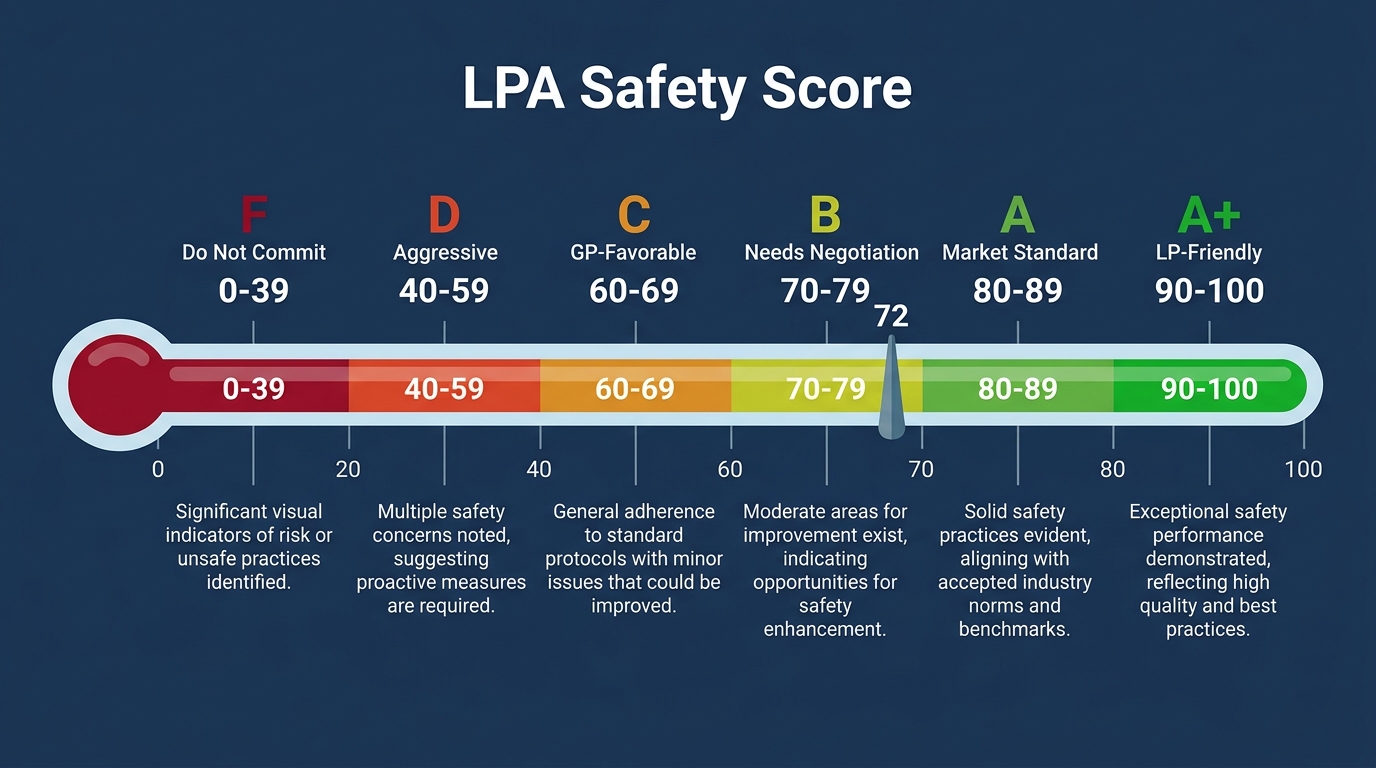
The Safety Score maps to a letter grade with a clear action prescription:
A+ (90-100) -- LP-Friendly
What it means: This LPA has strong LP protections across every dimension. Fee terms are at or below market median. Governance provisions include LPAC with real authority, no-fault removal rights, and key person clauses with meaningful consequences. The waterfall is European-style or includes robust clawback mechanics. Compliance is clean across all applicable frameworks.
What to do: Proceed with standard due diligence. This is a document you can sign with confidence. Focus your remaining review on operational items -- the legal terms are in your favor.
How common: Rare. Fewer than 10% of LPAs score here. Typically seen in funds from established managers raising from sophisticated institutional LPs who negotiated aggressively.
A (80-89) -- Market Standard
What it means: The LPA is generally balanced and within industry norms. There may be minor issues -- a management fee 25bps above median, a GP catch-up that is slightly aggressive, or a reporting obligation that lacks specificity -- but nothing that fundamentally shifts the risk balance.
What to do: Review the specific items flagged by the Recommendations Engine. You may want to negotiate one or two points, but these are refinements, not dealbreakers. Most institutional LPs would be comfortable committing at this level.
How common: This is the sweet spot. Roughly 25-30% of LPAs from established managers land here.
B (70-79) -- Needs Negotiation
What it means: The LPA has some concerning provisions that merit specific attention. You might see a fee offset below 80%, a waterfall with unusual carve-outs, governance that gives the GP unilateral discretion in key areas, or compliance gaps in one or two frameworks.
What to do: Generate the full PDF report and share it with your legal counsel. Use the Recommendations Engine output as a starting point for a side letter or amendment request. Prioritize the P0 and P1 items. Do not commit capital without at least attempting to negotiate the flagged provisions.
How common: The most common range. About 35% of LPAs fall here.
C (60-69) -- GP-Favorable
What it means: Multiple risky terms tilt the document in the GP's favor. You may see above-market fees with no offset, American-style waterfall without adequate clawback, limited LPAC authority, weak key person provisions, or significant GP discretion over valuations and conflicts.
What to do: This requires serious negotiation before committing capital. Engage legal counsel. Use the benchmarking data to demonstrate where terms deviate from market standard. Consider whether the GP's track record justifies the asymmetry -- sometimes it does, but you should be making that trade-off consciously, not unknowingly.
How common: About 20% of LPAs, often from emerging managers or funds where the GP has significant leverage.
D (40-59) -- Aggressive
What it means: Significant risks across multiple dimensions. The document may contain poison pills -- buried fee offsets that net to zero, waterfall carve-outs that redirect economics, or governance provisions that effectively strip LP rights. Compliance may have gaps in critical frameworks.
What to do: Do not commit capital without substantial revisions. Engage experienced fund formation counsel. The Recommendations Engine will produce a long list of P0 and P1 items -- treat that list as a minimum negotiation agenda. Consider whether this GP relationship is worth the effort required to bring these terms to market standard.
How common: About 8-10% of LPAs. Often seen in first-time funds with inexperienced counsel, or in situations where the GP is deliberately pushing aggressive terms.
F (0-39) -- Do Not Commit
What it means: Major revisions required. The document has potential dealbreakers -- provisions that could result in unlimited liability, total loss of governance rights, or regulatory violations. This is not a negotiation starting point; this is a document that needs to be rewritten.
What to do: Do not proceed. Share the analysis with the GP and explain that the terms are not investable in their current form. If the relationship matters, offer to work with the GP's counsel on a revised draft. If the GP is unwilling to revise, walk away.
How common: Under 5% of LPAs from legitimate managers. If you see this score, it is a serious red flag about the GP's intentions or competence.
Example Score Breakdown
Here is a real-world example using Apex Capital Partners Fund III, a mid-market PE fund:
Overall Safety Score: 74 (Grade B -- Needs Negotiation)
| Agent | Raw Score | Weight | Weighted Contribution |
|---|---|---|---|
| Terms & Provisions | 78 | 20% | 15.6 |
| Risk Assessment | 68 | 25% | 17.0 |
| Regulatory Compliance | 82 | 20% | 16.4 |
| Obligations & Timeline | 75 | 15% | 11.25 |
| Recommendations Engine | 69 | 20% | 13.8 |
| Composite | 100% | 74.05 |
What This Tells Us
- Terms (78): The LPA is reasonably complete. Most standard provisions are present, but the fee structure (2.0% management fee on committed capital throughout the fund life, no step-down) is above PE median.
- Risk (68): This is the weakest dimension. The risk agent flagged GP discretion over valuation methodology, a waterfall with a 100% GP catch-up (aggressive vs. the more common 80% catch-up), and a clawback that is net of taxes with no escrow.
- Compliance (82): Clean on SEC, ERISA, and AML frameworks. Minor gap: the subscription documents do not explicitly address CRS self-certification for non-U.S. investors.
- Obligations (75): Capital call mechanics are standard. However, the extension provision allows two 1-year extensions at GP sole discretion (market standard requires LP advisory committee consent).
- Recommendations (69): The engine generated 3 P0 items and 7 P1 items. The lower score reflects the volume of actionable issues and the difficulty of the negotiation -- several flagged items are structural (waterfall, catch-up) rather than cosmetic.
The Action Plan
For Apex Capital Partners Fund III, the LP should:
- Negotiate the management fee: Request a step-down to 1.5% on invested capital after the investment period (market standard for mid-market PE).
- Address the catch-up: Push for an 80% GP catch-up instead of 100%, or negotiate a higher preferred return to compensate.
- Strengthen the clawback: Request a clawback escrow of 25-30% of carried interest distributions, not just a personal guarantee net of taxes.
- Require LPAC consent for extensions: Change from GP sole discretion to LPAC approval for fund term extensions.
- Add CRS provisions: Include self-certification requirements in subscription documents for international investors.
How to Interpret Results
Context Matters
The Safety Score is a starting point, not a final verdict. A score of 72 from a first-time fund manager means something very different from a 72 from a top-decile manager on Fund VII. Consider:
- Manager track record: Established managers with strong returns may justify slightly more GP-favorable terms.
- Fund strategy: Venture capital LPAs typically have different norms than buyout funds. A VC fund with no preferred return scores lower on that metric, but that is market standard for VC.
- Your negotiating position: A $500M commitment gives you more leverage than a $5M commitment. The score tells you what to negotiate; your position determines what you can negotiate.
- Side letter rights: Many LPs negotiate better terms via side letters. The Safety Score reflects the base LPA only.
Reading the Agent-Level Scores
When the composite score is in the B or C range, look at the agent-level breakdown:
- One low agent, others high: The issue is concentrated. You can target your negotiation narrowly.
- All agents clustered around the same score: The issues are systemic. The entire document tilts GP-favorable, and you will need a broader negotiation.
- Compliance agent low, others high: This is urgent. Compliance failures are not negotiable -- they need to be fixed regardless of commercial terms.
Tracking Over Time
If you are reviewing a GP's terms across fund vintages (Fund I, II, III), the Safety Score trend tells you whether the GP is becoming more or less LP-friendly as they gain leverage. A declining score across vintages is a yellow flag worth discussing with the GP directly.
What to Do at Each Grade Level
| Grade | Action | Timeline | Who to Involve |
|---|---|---|---|
| A+ (90-100) | Proceed to allocation decision | Standard diligence timeline | Investment team |
| A (80-89) | Review flagged items, negotiate if easy | 1-2 weeks for legal review | Investment team + legal |
| B (70-79) | Negotiate specific provisions, consider side letter | 2-4 weeks for negotiation | Legal counsel + investment team |
| C (60-69) | Serious negotiation required before commitment | 4-8 weeks minimum | External fund formation counsel |
| D (40-59) | Major revisions or walk away | Indefinite until resolved | Senior legal + investment committee |
| F (0-39) | Do not commit -- communicate concerns to GP | Immediate escalation | Investment committee + senior counsel |