
5-Agent Architecture
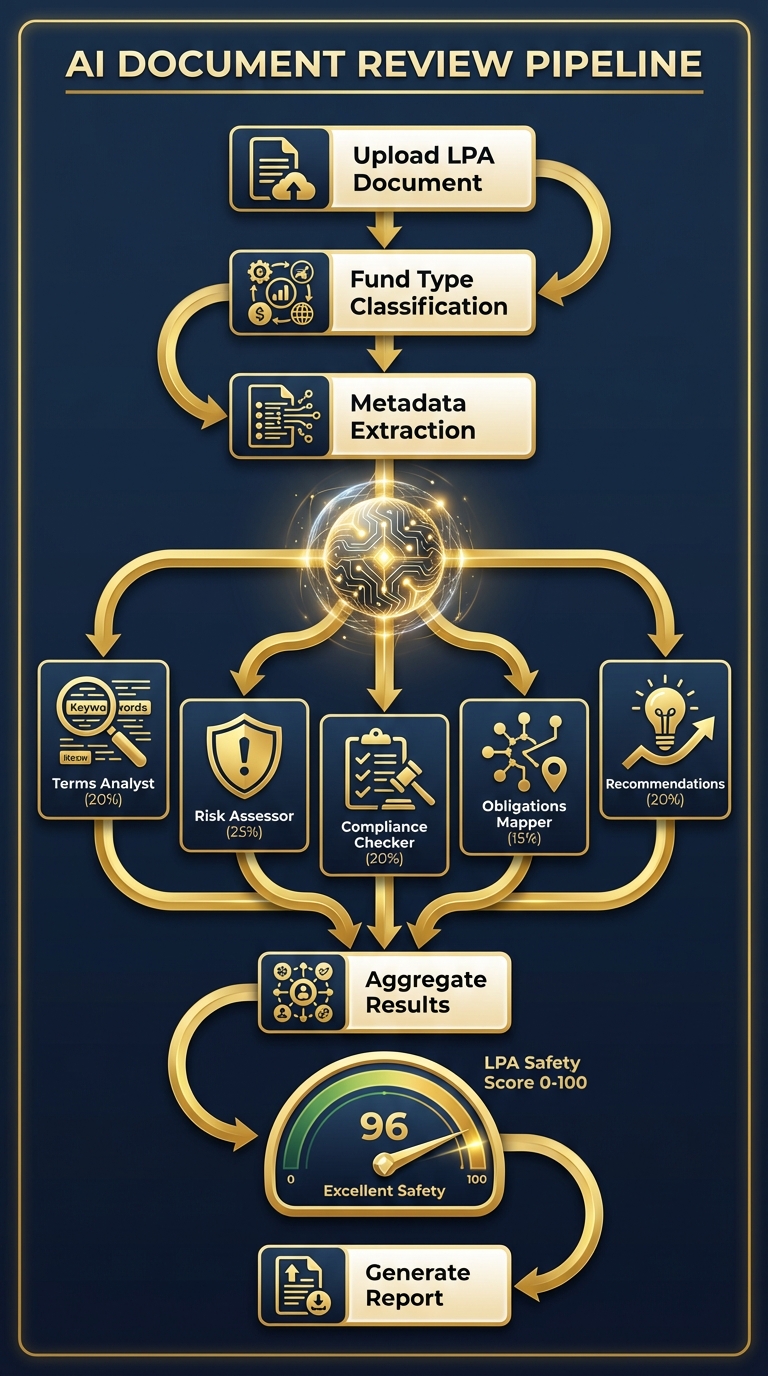
FundAdmin AI does not rely on a single AI model to analyze your LPA. Instead, it deploys five specialized agents in parallel, each focused on a distinct analytical domain. This architecture is the foundation of the platform's 59 skills across 14 categories -- the agents handle LPA review while the broader skill suite covers everything from document intake and investor onboarding to portfolio intelligence and Obsidian vault management. This page covers the five-agent LPA review pipeline specifically.
Overview
When you submit an LPA for review, the document is simultaneously processed by all five agents:
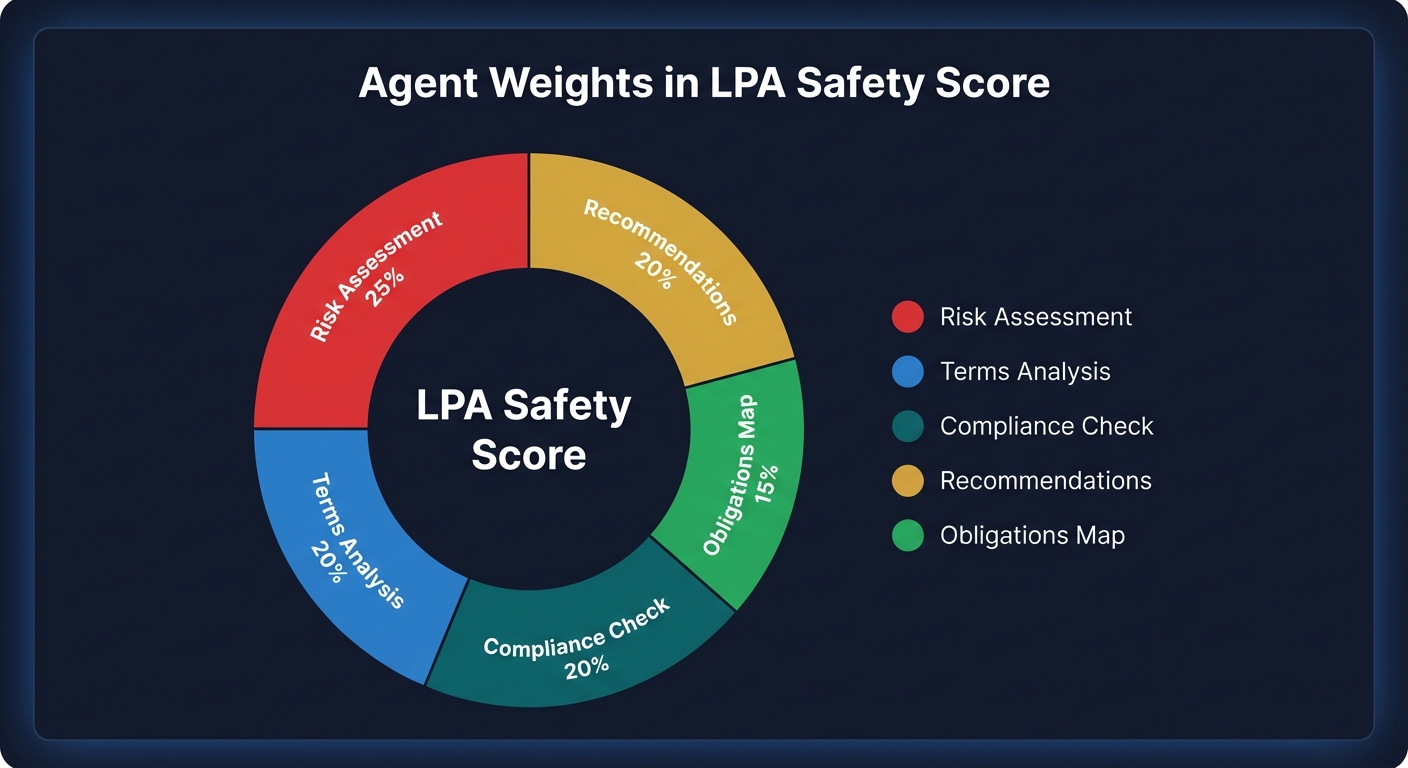
- Terms & Provisions Analyst (20% weight)
- Risk Assessment (25% weight)
- Regulatory Compliance (20% weight)
- Obligations & Timeline (15% weight)
- Recommendations Engine (20% weight)
Each agent operates independently with its own prompt architecture, scoring rubric, and output schema. The agents do not communicate with each other during analysis -- this is by design. Independent analysis prevents anchoring bias, where one agent's findings influence another's judgment.
After all five agents complete their analysis, the orchestrator combines their outputs into:
- A composite Safety Score (0-100)
- A structured JSON report with every finding, score, and recommendation
- A PDF report with visualizations, tables, and negotiation guidance
Why Parallel, Not Sequential?
Sequential analysis creates dependency chains. If Agent 1 mischaracterizes a provision, Agents 2-5 inherit the error. Parallel execution means each agent forms its own interpretation from the raw text, and discrepancies between agents surface as cross-validation signals rather than compounding errors.
Parallel execution also means the analysis completes in the time of the slowest agent, not the sum of all agents. A typical 80-page LPA completes in 60-90 seconds.
Agent 1: Terms & Provisions Analyst
Weight: 20% of Safety Score
Role
The Terms & Provisions Analyst is the foundation layer. Its job is to extract, categorize, and inventory every defined term, fee provision, waterfall mechanic, and structural element in the LPA. It does not judge whether terms are good or bad -- that is the Risk agent's job. The Terms agent answers: "What is actually in this document?"
Provision Taxonomy
The agent classifies every extracted provision into one of 15+ categories using a standardized taxonomy:
| Code | Category | What It Covers |
|---|---|---|
FEE | Fee Provisions | Management fees, transaction fees, monitoring fees, broken-deal expenses, organizational expenses |
CARRY | Carried Interest | Carry percentage, hurdle rates, catch-up mechanics, crystallization frequency |
WF | Waterfall | Distribution waterfall tiers, European vs American style, recycling provisions |
GOV | Governance | GP removal, LPAC composition and authority, voting thresholds, consent rights |
RPT | Related Party Transactions | Affiliate dealings, co-investment allocation, conflicts of interest |
LP | LP Rights & Protections | Information rights, transfer restrictions, excuse/exclude provisions, MFN |
CAP | Capital | Commitment mechanics, capital call procedures, default provisions, over-commitment |
XFER | Transfer & Liquidity | Transfer restrictions, ROFR, secondary market provisions, tag-along/drag-along |
CONF | Confidentiality | Confidentiality obligations, FOIA carve-outs, data protection |
INDEM | Indemnification | GP indemnification scope, standard of care, exculpation, insurance |
TERM | Term & Dissolution | Fund term, extension provisions, early dissolution triggers, wind-down mechanics |
CLAW | Clawback | GP clawback mechanics, escrow provisions, tax adjustments, joint vs several |
COINV | Co-Investment | Co-investment rights, allocation methodology, fee/carry on co-invest |
SL | Side Letters | MFN provisions, side letter disclosure, amendment mechanics |
VAL | Valuation | Valuation methodology, frequency, auditor selection, GP discretion scope |
Output
The Terms agent produces four deliverables:
Provision Inventory: A complete list of every provision found, tagged by category, with page references and exact quoted language.
Defined Terms Registry: Every capitalized defined term in the LPA, its definition, and cross-references to where it is used. This catches inconsistencies -- for example, when "Net Asset Value" is defined one way in Section 1 but used differently in the waterfall calculation.
Gap Analysis: A list of standard provisions that are missing from the document. A PE LPA without a clawback provision, for example, is a significant gap. The agent checks against fund-type-specific templates to identify what should be there but is not.
Completeness Scores: Each provision category receives a 1-5 completeness score:
| Score | Meaning |
|---|---|
| 5 | Comprehensive -- all expected provisions present with full detail |
| 4 | Substantially complete -- minor items missing but core terms are present |
| 3 | Adequate -- key provisions present but lacking specificity in some areas |
| 2 | Incomplete -- significant provisions missing or underspecified |
| 1 | Deficient -- category is barely addressed or absent |
Fund-Type Weighting
The Terms agent adjusts its expectations based on fund type. What is "standard" for a PE buyout fund differs materially from a VC fund, a hedge fund, a real estate fund, or a credit fund:
| Provision | PE Buyout | Venture Capital | Hedge Fund | Real Estate | Credit |
|---|---|---|---|---|---|
| Preferred return | Expected (8%) | Often absent | N/A | Expected (8-10%) | Expected (6-8%) |
| Clawback | Required | Common | N/A | Required | Required |
| Key person | Expected | Expected | Less common | Expected | Common |
| High watermark | N/A | N/A | Standard | N/A | N/A |
| Redemption rights | N/A | N/A | Standard | N/A | Sometimes |
| Investment period | 5-6 years | 3-5 years | N/A | 3-5 years | 2-4 years |
Agent 2: Risk Assessment
Weight: 25% of Safety Score
Role
The Risk Assessment agent carries the highest weight because it answers the most critical question: "How much financial and structural risk does this LPA create for the LP?" While the Terms agent extracts what is in the document, the Risk agent evaluates whether those terms are dangerous.
Every provision identified by the Terms agent is scored on a 1-10 risk scale, where 1 is minimal risk and 10 is extreme risk.
Risk Dimensions
The agent evaluates risk across ten dimensions:
| Dimension | What It Measures |
|---|---|
| Fee Risk | Total economic drag from all fee layers, fee offsets (or lack thereof), hidden expenses |
| Liquidity Risk | Lock-up period, transfer restrictions, redemption limitations, secondary market friction |
| Governance Risk | LP ability to influence or constrain GP behavior, voting rights, removal mechanics |
| Regulatory Risk | Exposure to regulatory action, framework gaps, qualification failures |
| Operational Risk | Administrator quality, auditor selection, insurance requirements, key person dependency |
| GP-LP Asymmetry | Provisions that disproportionately favor the GP -- the single most important dimension |
| Concentration Risk | Investment limits, diversification requirements, sector/geography constraints |
| Valuation Risk | GP discretion over NAV, mark-to-market frequency, auditor independence |
| Key Person Risk | Dependency on named individuals, consequences of departure, replacement mechanics |
| Clawback Risk | Strength of clawback mechanics, escrow adequacy, tax-adjusted vs gross clawback |
Scoring Formula
Each provision's risk score is computed using a weighted formula:
Risk Score = (Severity * 0.40) + (Likelihood * 0.25) + (Financial Exposure * 0.20) + (Asymmetry * 0.15)| Component | Weight | What It Measures |
|---|---|---|
| Severity | 40% | How bad is the worst-case outcome? A 100% GP catch-up is more severe than a 25bps fee variance. |
| Likelihood | 25% | How likely is the risk to materialize? Extension provisions are almost always exercised; key person events are less frequent. |
| Financial Exposure | 20% | What is the dollar impact? A 2% management fee on a $1B fund is $20M/year; a missing FOIA carve-out has no direct financial cost. |
| Asymmetry | 15% | Does this provision create an imbalance? GP unilateral discretion scores high; provisions requiring LP consent score low. |
Poison Pill Detection
The Risk agent includes a specialized sub-routine for detecting poison pills -- provisions that appear benign on the surface but have outsized negative impact:
Buried Fee Offsets: The LPA states that management fees are offset by portfolio company fees, but the offset applies only to "net" fees after the GP deducts "costs and expenses related to the provision of such services." In practice, the offset nets to near zero.
Waterfall Carve-Outs: The distribution waterfall follows a standard European structure, but includes a carve-out for "interim distributions" that allows the GP to receive carried interest before return of capital on an interim, deal-by-deal basis -- effectively converting a European waterfall into an American one.
GP Discretion Clauses: Provisions that give the GP "sole and absolute discretion" over material matters -- valuation methodology, conflict resolution, expense allocation, or extension decisions -- without LP or LPAC consent.
Definitional Traps: Narrow definitions that limit LP protections. For example, "Cause" for GP removal defined so narrowly (only criminal conviction) that it is practically impossible to invoke.
Cross-Reference Conflicts: Provisions in one section that are undermined by exceptions buried in another section. The Risk agent cross-references every material provision against the full document to catch these.
When a poison pill is detected, it is flagged as a P0 (Dealbreaker) finding and highlighted in the report with exact page references and explanatory context.
Agent 3: Regulatory Compliance
Weight: 20% of Safety Score
Role
The Regulatory Compliance agent checks the LPA against every applicable regulatory framework. Compliance is binary in a way that other dimensions are not -- a fund either meets ERISA requirements or it does not. There is no "somewhat compliant."
Frameworks Checked
The agent evaluates compliance across U.S. federal, European/international, and industry-standard frameworks:
U.S. Federal Frameworks:
| Framework | Key Check |
|---|---|
| SEC / Investment Advisers Act | Registration status, Form ADV disclosure, fiduciary obligations |
| Form PF | Reporting thresholds ($1.5B+ hedge, $2B+ PE), filing obligations |
| Form D | Reg D exemption, 15-day filing requirement, accredited investor verification |
| ERISA | 25% plan asset test, VCOC/REOC exemptions, prohibited transaction rules |
| FATCA | Chapter 4 withholding, W-8/W-9 collection, entity classification (FFI/NFFE) |
| AML/BSA/FinCEN | KYC requirements, beneficial ownership, sanctions screening (OFAC) |
| Form 13F | $100M+ quarterly holdings reporting |
European/International Frameworks:
| Framework | Key Check |
|---|---|
| AIFMD | Annex IV reporting, leverage calculation and disclosure, depositary requirements |
| SFDR | Article 6/8/9 classification, principal adverse impact (PAI) indicators |
| CRS | Multi-jurisdiction investor reporting, self-certification requirements |
| GDPR | Data protection for investor personal data, cross-border transfer mechanisms |
Industry Standards:
| Standard | Key Check |
|---|---|
| ILPA Best Practices | Fee reporting template compliance, DDQ completeness, governance standards |
| SOC 1 / SOC 2 | Controls reporting requirements for fund administrators |
Investor Qualification Verification
The agent verifies that the LPA properly addresses investor qualification thresholds:
| Qualification Level | Natural Person Threshold | Entity Threshold |
|---|---|---|
| Accredited Investor | $1M net worth (excl. primary residence) or $200K/$300K income | $5M in assets |
| Qualified Client (QC) | $2.2M net worth or $1.1M AUM | $2.2M net worth |
| Qualified Purchaser (QP) | $5M in investments | $25M in investments |
The agent checks whether the subscription documents correctly implement these thresholds and whether the LPA terms are consistent with the exemptions claimed (e.g., a fund relying on Section 3(c)(7) must restrict to Qualified Purchasers).
Output Format
Each framework receives a status:
| Status | Meaning |
|---|---|
| PASS | Full compliance with all requirements of the framework |
| WARNING | Substantially compliant but with minor gaps that should be addressed |
| FAIL | Material non-compliance that creates legal or regulatory risk |
A single FAIL in any critical framework (SEC, ERISA, AML) will significantly impact the composite Safety Score, because regulatory failure can invalidate the entire fund structure.
Agent 4: Obligations & Timeline
Weight: 15% of Safety Score
Role
The Obligations & Timeline agent maps every obligation, deadline, trigger event, and notice period in the LPA. Its purpose is to answer: "What am I required to do, when, and what happens if I miss it?"
LPAs create a web of bilateral obligations -- the GP must report quarterly, the LP must fund capital calls within 10 business days, the administrator must deliver audited financials within 90 days of fiscal year-end. Missing any of these can trigger defaults, penalties, or forfeiture of rights.
Obligation Types
The agent categorizes obligations into ten types:
| Type | Examples |
|---|---|
| Capital Call | Funding deadlines, default provisions, cure periods, penalty interest rates |
| Distribution | Distribution timing, in-kind distribution rules, withholding mechanics |
| Reporting | Quarterly reports, annual audited financials, capital account statements, K-1 timing |
| Filing | Tax filings, regulatory filings, blue sky notices |
| Notice | Required notice periods for transfers, withdrawals, elections, or consents |
| Consent | LP consent thresholds, LPAC approval requirements, supermajority provisions |
| Valuation | Valuation frequency, methodology disclosure, auditor review requirements |
| Audit | Annual audit timing, auditor selection, LP access to books and records |
| Insurance | D&O coverage requirements, E&O insurance, key person insurance |
| Restrictive | Non-compete, non-solicit, exclusivity, most-favored-nation deadlines |
Fund Lifecycle Phases
The agent maps every obligation to its position in the fund lifecycle:
Formation ──> Investment Period ──> Harvest Period ──> Wind-Down
  (Year 0)      (Years 1-5)        (Years 6-10)     (Years 10+)
Formation Phase: Subscription closings, initial capital calls, organizational expense caps, GP commitment funding, regulatory filings (Form D within 15 days of first closing).
Investment Period: Capital call mechanics, investment restrictions, concentration limits, follow-on reserve policies, co-investment allocation procedures. The investment period is when the GP has maximum discretion and the LP has maximum exposure.
Harvest Period: Portfolio management, add-on investments (if permitted), distribution waterfalls, valuation cadence, reporting intensification. This is when the economic terms -- carry, catch-up, clawback -- become operative.
Wind-Down: Extension provisions, liquidation procedures, in-kind distribution rules, final audit, final K-1 delivery, partnership dissolution mechanics.
Auto-Renewal and Extension Trap Analysis
One of the most impactful findings the Obligations agent produces is its extension trap analysis. Many LPAs include provisions that automatically extend the fund term unless LPs affirmatively act:
- GP sole discretion extensions: The GP can extend the fund by 1-2 years without any LP approval. This locks up capital beyond the stated term.
- Auto-renewal provisions: The fund term automatically renews unless a supermajority of LPs vote to dissolve -- an almost impossible threshold to meet.
- Staggered extensions: Multiple sequential 1-year extensions that compound (e.g., "two additional 1-year periods at GP discretion" means up to 2 extra years with no LP recourse).
- Harvest period ambiguity: The investment period ends, but the GP retains broad discretion to make "follow-on" investments, effectively extending the investment period under a different name.
The agent flags these traps with specific language references and recommends LPAC consent requirements as the standard remedy.
Output: Obligation Timeline
The agent produces a chronological timeline showing every obligation mapped to its trigger date or event, the responsible party (GP, LP, administrator, auditor), the consequence of non-compliance, and the cure period (if any).
Agent 5: Recommendations Engine
Weight: 20% of Safety Score
Role
The Recommendations Engine is the action layer. While other agents diagnose, this agent prescribes. It synthesizes findings from the analysis into a prioritized list of negotiation items, each with specific alternative language, market-standard benchmarks, and a negotiation script.
Priority Tiers
Every recommendation is assigned a priority tier:
| Tier | Label | Meaning | Action |
|---|---|---|---|
| P0 | Dealbreaker | This provision, if unchanged, should prevent capital commitment | Must negotiate before signing |
| P1 | High Priority | Material impact on LP economics or rights | Strongly recommend negotiation |
| P2 | Medium Priority | Above-market or non-standard, but not disqualifying | Negotiate if possible |
| P3 | Low Priority | Minor deviation from best practice | Address in side letter if convenient |
| P4 | Cosmetic | Drafting improvements, clarifications, typos | Note for GP counsel, no commercial impact |
Market-Standard Benchmarking
Every recommendation includes a benchmark comparison. The engine does not just say "this fee is high" -- it says:
"Management fee of 2.0% on committed capital is 25bps above the PE median of 1.75%. Furthermore, the absence of a step-down to invested capital after the investment period places this in the top quartile of GP-favorable fee structures. Recommended alternative: 1.75% on committed capital during investment period, stepping down to 1.5% on invested capital thereafter."
The benchmarks are sourced from industry data covering fund-type-specific medians, quartile ranges, and trend data.
Negotiation Scripts
For P0 and P1 items, the engine generates negotiation scripts framed specifically for GP-LP dynamics. These are not generic legal suggestions -- they are calibrated for the power dynamic of a capital allocator negotiating with a fund manager:
Example negotiation script for a missing clawback escrow:
"We are very supportive of the fund and the team. One item we would like to discuss is the clawback mechanic. While we appreciate that the clawback obligation is included, our investment committee requires an escrow of 25-30% of carried interest distributions to ensure the clawback is practically enforceable. This is consistent with ILPA best practices and what we see in the majority of our fund investments. We believe this is a straightforward addition that does not impact the GP's economics in any scenario where the fund performs as expected."
The scripts are designed to:
- Lead with alignment and support for the fund
- Frame the ask as an institutional requirement, not a personal objection
- Reference market standards and ILPA best practices as external authority
- Minimize perceived impact on the GP's economics
- Position the LP as a sophisticated, experienced allocator
Recommendation Output Structure
Each recommendation includes:
- Finding: What was identified and where (section, page, exact language)
- Risk Level: How this finding maps to the risk scoring
- Benchmark: What market standard looks like for this provision
- Recommended Language: Specific alternative drafting language
- Negotiation Script: How to raise this with the GP
- Fallback Position: If the GP rejects the primary ask, what is an acceptable compromise
- Side Letter Suitability: Whether this item can be addressed via side letter rather than LPA amendment