
Agent System
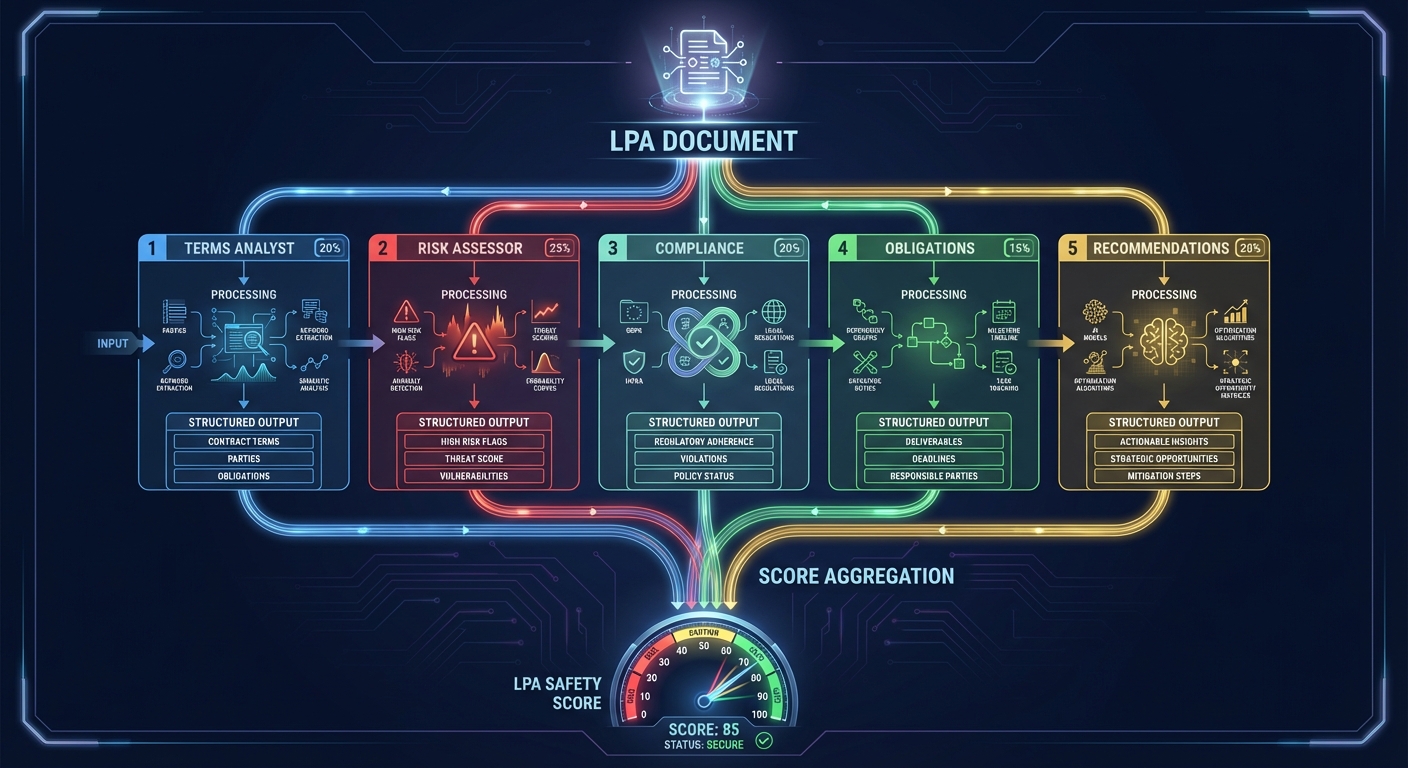
The agent system is the analytical engine behind FundAdmin AI's flagship /fund review-lpa command. Five specialized agents run in parallel, each analyzing the same document from a different perspective. Their findings are then synthesized into a single comprehensive report with a weighted LPA Safety Score.
When Agents Are Used
Agents are only used by the /fund review-lpa command. All other 58 commands use single-skill processing without agents. The LPA review is the most complex analysis FundAdmin AI performs, and the multi-agent architecture ensures thorough coverage across all dimensions of an LPA.
How Parallel Processing Works
When /fund review-lpa is invoked:
- Document ingestion -- The skill reads the full document, classifies the fund type, and extracts metadata
- Agent dispatch -- All 5 agents launch simultaneously, each receiving:
- The full document text
- Fund type classification (PE, VC, hedge fund, real estate, credit)
- Extracted metadata (fund name, parties, dates, jurisdiction)
- Parallel analysis -- Each agent analyzes the document through its specialized lens
- Structured output -- Each agent produces findings in a defined format with risk ratings
- Synthesis -- A synthesis step merges all agent findings, resolves conflicts, and calculates the weighted LPA Safety Score
The 5 Agents
1. Terms & Economics Agent
| Property | Value |
|---|---|
| File | agents/fund-terms.md |
| Weight | 20% of LPA Safety Score |
| Focus | Fee structures, waterfall mechanics, economic alignment |
What it analyzes:
- Management fee (rate, basis, step-down, offsets, fee holidays)
- Carried interest (rate, hurdle rate, catch-up provision, clawback)
- Preferred return (rate, compounding method, unpaid accumulation)
- Organizational expenses (cap, GP contribution to expenses)
- Fund expenses (scope of chargeable expenses, expense cap)
- GP commitment (percentage, form of contribution, co-investment)
- Waterfall structure (American vs. European, distribution mechanics)
- Fee offset provisions (management company fee offsets, transaction fee offsets)
Scoring criteria:
- Market-standard terms receive full marks
- Aggressive GP-favorable terms (e.g., 25% carry with no hurdle) are penalized
- Missing provisions (e.g., no clawback) receive zero marks in that category
- Unusual structures are flagged even if not necessarily negative
2. Risk Assessment Agent
| Property | Value |
|---|---|
| File | agents/fund-risks.md |
| Weight | 25% of LPA Safety Score |
| Focus | Legal risk, structural risk, conflict identification |
What it analyzes:
- Conflicts of interest (affiliated transactions, allocation conflicts, GP-related activities)
- Indemnification scope (breadth of GP indemnification, carve-outs for bad acts)
- Limitation of liability (gross negligence standard, willful misconduct, fraud)
- Confidentiality provisions (scope, exceptions, duration, remedies)
- Amendment provisions (LP consent thresholds, GP unilateral amendment rights)
- Borrowing and leverage (fund-level leverage limits, subscription line facilities)
- Investment restrictions (concentration limits, geographic restrictions, asset class limits)
- Recycling provisions (scope, time limits, investor consent)
- GP removal provisions (cause and no-fault mechanisms, supermajority thresholds)
Scoring criteria:
- Balanced risk allocation receives full marks
- Broad GP discretion without LP protections is penalized heavily
- Missing standard protections (e.g., no cause removal) are flagged as high risk
- Risk score carries the highest weight (25%) because structural risks have the greatest impact on investor outcomes
3. Compliance Agent
| Property | Value |
|---|---|
| File | agents/fund-compliance.md |
| Weight | 20% of LPA Safety Score |
| Focus | Regulatory alignment, filing obligations, compliance infrastructure |
What it analyzes:
- FATCA compliance (entity classification, withholding obligations, GIIN requirements)
- CRS compliance (reporting obligations, self-certification requirements)
- AML/KYC provisions (investor verification requirements, ongoing monitoring)
- ERISA considerations (benefit plan investor limitations, 25% test provisions, VCOC/REOC)
- AIFMD provisions (marketing restrictions, depositary requirements, reporting)
- SFDR classification (Article 6/8/9, sustainability disclosures, PAI indicators)
- Form PF / Form ADV implications (reporting triggers, filing obligations)
- Tax reporting provisions (K-1 delivery timing, tax distribution provisions, withholding)
- Anti-corruption and sanctions (OFAC compliance, FCPA provisions)
Scoring criteria:
- Comprehensive regulatory coverage receives full marks
- Missing regulatory provisions are penalized based on the severity of the regulatory requirement
- Outdated references to superseded regulations are flagged
- Jurisdictional coverage is evaluated relative to the fund's investor base and investment targets
4. Obligations Agent
| Property | Value |
|---|---|
| File | agents/fund-obligations.md |
| Weight | 15% of LPA Safety Score |
| Focus | GP obligations, LP rights, governance provisions |
What it analyzes:
- Reporting obligations (frequency, content, timing of financial and operational reports)
- Audit rights (scope, frequency, LP access to books and records)
- LPAC provisions (composition, authority, consent rights, meeting frequency)
- Key person provisions (named individuals, trigger events, consequences, cure periods)
- No-fault divorce (LP right to remove GP without cause, supermajority threshold)
- Transfer restrictions (LP transferability, GP consent requirements, ROFR)
- Excuse and exclusion rights (investment-level opt-out, ESG exclusions, legal conflicts)
- Co-investment rights (allocation methodology, priority, vehicle structure)
- Information rights (access to portfolio company data, valuation reports, tax information)
- MFN provisions (most favored nation protections, election mechanics, carve-outs)
Scoring criteria:
- Strong LP governance rights receive full marks
- Absent governance provisions (e.g., no LPAC, no key person) are penalized
- Obligations are evaluated for enforceability and specificity
- Vague or discretionary obligations are flagged as medium risk
5. Recommendations Agent
| Property | Value |
|---|---|
| File | agents/fund-recommendations.md |
| Weight | 20% of LPA Safety Score |
| Focus | Actionable recommendations, negotiation priorities, market comparison |
What it analyzes:
- Terms that deviate from market standard (based on fund type and vintage)
- Provisions that should be negotiated before signing
- Missing provisions that should be added via side letter
- Strengths of the LPA worth preserving
- Comparison against ILPA best practices and model LPA provisions
- Priority ranking of recommendations (P0 = dealbreaker, P1 = strongly recommended, P2 = recommended, P3 = nice-to-have, P4 = minor observation)
Scoring criteria:
- The recommendations agent's score reflects the overall negotiability and investor-friendliness of the LPA
- LPAs with few needed changes score higher
- LPAs with multiple P0 (dealbreaker) items score significantly lower
- The score accounts for the cumulative impact of all recommended changes
Agent File Format
Each agent file in agents/ follows a consistent structure:
Role Definition
# Fund Terms & Economics Agent

**Weight in LPA Safety Score**: 20%
**Agent ID**: fund-terms
Mission Statement
A clear description of what the agent is responsible for analyzing and why.
Taxonomy / Categories
The specific categories and subcategories the agent evaluates, organized as a structured list or table.
Step-by-Step Analysis Process
Numbered steps the agent follows when analyzing a document:
- Extract all relevant provisions
- Classify each provision against the taxonomy
- Compare against market benchmarks
- Assign risk ratings (high / medium / low)
- Score each category
- Produce structured findings
Scoring Criteria
How the agent calculates its score, including:
- Point allocation per category
- Penalty rules for missing or aggressive provisions
- Benchmark reference points
Output Format Specification
The exact structure of the agent's output, including section headings, table formats, and required fields.
Handoff Instructions
How the agent's output feeds into the synthesis engine:
- Output format (structured sections with scores)
- Score normalization (0-100 scale)
- Finding severity classification (high / medium / low)
- How conflicts with other agents' findings should be resolved
Disclaimer
The standard disclaimer included in all agent outputs.
LPA Safety Score Calculation
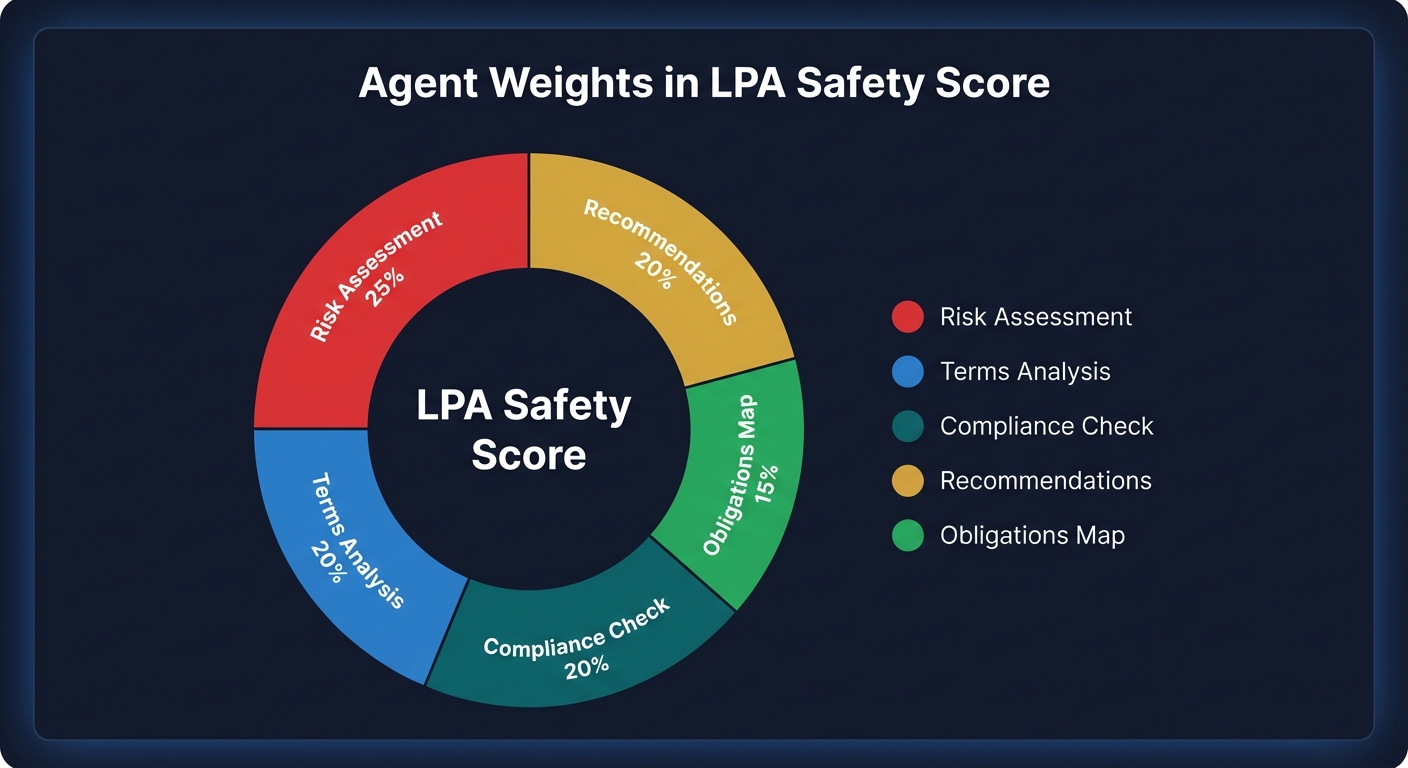
The LPA Safety Score is a weighted composite of all five agent scores:
| Agent | Weight | Score Range | Example |
|---|---|---|---|
| Terms & Economics | 20% | 0-100 | 72 |
| Risk Assessment | 25% | 0-100 | 65 |
| Compliance | 20% | 0-100 | 88 |
| Obligations | 15% | 0-100 | 70 |
| Recommendations | 20% | 0-100 | 60 |
| Weighted Total | 100% | 0-100 | 70.3 |
Score interpretation:
| Range | Grade | Meaning |
|---|---|---|
| 90-100 | A | Investor-friendly, market-standard or better terms |
| 80-89 | B | Generally favorable with minor negotiation points |
| 70-79 | C | Acceptable but several provisions warrant negotiation |
| 60-69 | D | Below market standard, significant negotiation recommended |
| 0-59 | F | Materially investor-unfriendly, major structural concerns |
Why Parallel Agents?
A single-pass analysis risks missing issues that only become apparent when viewed through a specific lens. For example:
- A management fee structure might look standard to a general reviewer but reveal hidden conflicts when analyzed by the risk agent alongside affiliated transaction provisions
- Compliance gaps are easy to overlook when focused on economic terms
- Governance provisions interact with each other in ways that a single-pass review may not catch (e.g., a weak key person clause combined with a broad GP assignment right)
By running five specialized perspectives in parallel, FundAdmin AI produces more thorough, more balanced, and more actionable analysis than any single-perspective approach.